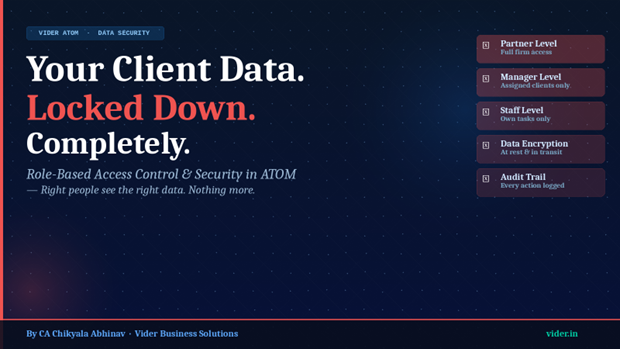
Your Client Data. Locked Down. Completely: Role-Based Access Control & Data Security in ATOM
How ATOM protects sensitive CA firm client data with granular access controls and complete audit trails
How ATOM protects sensitive CA firm client data with granular access controls and complete audit trails
CONTENTS
Home Chronicles ATOM


Chartered Accountants, by the nature of their work, hold some of the most sensitive financial information in existence. PAN numbers, bank account details, investment portfolios, salary structures, profit and loss statements, undisclosed income, ongoing litigation — all of this passes through a CA firm's hands as a routine part of practice.
The ICAI's Code of Ethics places a specific obligation of confidentiality on CAs. Clause 7 of the Code requires that members do not disclose confidential information acquired in the course of professional work unless required by law. This is not merely an ethical requirement — it is a professional liability. A CA whose client's data is leaked, accessed by an unauthorised party, or misused by a departing employee is exposed to serious professional and legal consequences.
Yet most CA firms manage this sensitive data with essentially no security infrastructure. Shared Excel files, WhatsApp groups with multiple members, email accounts without two-factor authentication, physical files that anyone can access. The gap between the sensitivity of the data and the security of its management is enormous.
ATOM's role-based access control and security architecture was designed specifically to close this gap — making professional-grade data security accessible to every CA firm, regardless of size.
Risk 1: Unauthorised Internal Access
The most common data security breach in a professional firm is internal — a junior staff member accessing client information they should no see, or a departing employee taking client data with them. Without access controls, there is no structural barrier preventing this.
Risk 2: Data Leakage Through Shared Tools
When client data lives in shared WhatsApp groups, unprotected Excel files, or personal email accounts, it is effectively uncontrolled. Any team member who leaves the firm retains access to that data indefinitely. Any device containing those files is a security risk if lost or stolen.
Risk 3: No Audit Trail
Without an audit trail, it is impossible to know who accessed what data, when, and why. In the event of a data breach or a client complaint about confidentiality, there is no evidence to investigate with.
“In a CA firm, client confidentiality is not just a professional value — it is a legal obligation. The tools you use to manage client data must reflect the sensitivity of that data.”
Four Access Levels
ATOM's access control operates across four levels, each with a specific scope of data visibility:
Custom Permission Sets
Beyond the four standard levels, ATOM allows custom permission sets for specific scenarios. A billing administrator who should see fee data but not client compliance details. A partner's PA who needs access to scheduling but not sensitive financial information. A quality reviewer who needs read-only access to completed work across all teams. All of these are configurable without technical expertise.
Data Encryption
All data in ATOM is encrypted both at rest and in transit. Client documents stored in ATOM are encrypted at the storage level. Data transmitted between users and the ATOM servers is secured via TLS encryption. This means that even if underlying storage were accessed by an unauthorised party, the data would be unreadable.
Complete Audit Trail
Every action taken in ATOM is logged: who accessed which client's record, when, what data they viewed, what changes they made. This audit trail is immutable — it cannot be edited or deleted by any user, including administrators. In the event of a data security concern, the complete history of data access is available for review.
| Security Feature | What It Does | Risk It Prevents |
| Role-based access | Limits data visibility by role | Internal unauthorised access |
| Data encryption | Encrypts all stored and transmitted data | External breach |
| Audit trail | Logs every data access and change | Undetected data misuse |
| Session management | Auto-logout on inactivity | Unattended device access |
| Two-factor auth | Verifies identity on login | Credential theft |
What happens to client data access when an employee leaves the firm?
When an employee is deactivated in ATOM, their access is revoked immediately. All data they had access to remains in the system — but they can no longer view, download, or export it. The deactivation takes effect in real time, meaning access is cut off the moment the action is taken, not at the next login attempt.
Can ATOM support two-factor authentication for all users?
Related Posts
Best Practice Management Tool for Chartered Accountants in India by CA Chikyala Abhinav Why ATOM Is the Best Practice Management Tool for Chartered Accountants in India by Nikhil Katkam P F A & Associates - Segment: Income Tax Advisory & Compliance How ATOM & ATOM Pro Revolutionized My CA Practice: A Journey by CA. Naveen Kumar Best Company Secretary Software in India - Vider ATOM