Home
Chronicles
ATOM
Compliance Calendar for Chartered Accountants (CA Firms): The Complete Guide to Never Missing Due Dates
By
CA Chikyala Abhinav
|
Updated on:Jan 10, 2025 15:16
|
16 min read
In a Chartered Accountant’s practice, missing a statutory due date is not a small operational lapse—it is a
business risk. Penalties, notices, client dissatisfaction, and reputational damage can arise from a single
missed compliance.
With GST, Income Tax, TDS, and MCA laws running in parallel, modern CA firms need more than reminders—they
need a centralized, automated compliance control system.
This pillar guide explains what a compliance calendar is, why manual tracking fails, and how compliance
calendar software—especially ATOM—helps CA firms operate risk-free at scale.
What Is a Compliance Calendar?
A Compliance Calendar is a structured system that tracks all statutory due dates applicable to a CA firm and
its clients, across multiple laws and filing frequencies.
Unlike a simple date list, a professional compliance calendar:
• Identifies which compliance applies to which client
• Tracks status (pending, filed, overdue)
• Sends automated reminders
• Integrates with task management
Types of Compliances Covered in a CA Compliance Calendar
1. GST Compliances
• GSTR-1 (Monthly / Quarterly)
• GSTR-3B
• CMP-08
• GSTR-9 / 9C
• GST Registration & Amendments
2. Income Tax Compliances
• ITR filing (Individuals, Firms, Companies)
• Advance Tax installments
• Tax Audit Reports (Form 3CD)
• Form 15CA / 15CB
• Capital Gains & Special filings
3. TDS & TCS Compliances
• Quarterly TDS returns (24Q, 26Q, 27Q)
• TCS returns (27EQ)
• TDS payments & challans
• TRACES-related filings
4. MCA & Corporate Compliances
• AOC-4
• MGT-7 / MGT-7A
• DIR-3 KYC
• Annual filings for Companies & LLPs
A proper compliance calendar ensures nothing is missed—regardless of volume.
Why Manual Compliance Tracking Fails in CA Firms
Despite best intentions, manual compliance systems are structurally weak.
Common issues with manual tracking:
• ❌ Human dependency on memory or Excel
• ❌ No centralized visibility across team members
• ❌ Missed follow-ups with clients
• ❌ No audit trail of who handled what
• ❌ Impossible to scale beyond a point
As client count increases, manual systems break silently—until a notice arrives.
How Compliance Calendar Software Transforms CA Practice
A dedicated compliance calendar software converts compliance into a repeatable, auditable, and automated
workflow.
Key advantages:
• Centralized dashboard for all due dates
• Client-wise and law-wise visibility
• Automated reminders for staff and clients
• Task ownership and accountability
• Reduced penalties and notices
• Better client confidence and retention
This shifts the firm from firefighting mode to process-driven operations.
What an Ideal Compliance Calendar for CA Firms Must Have
Before choosing any tool, ensure it includes:
1. Client-specific compliance applicability
2. Auto-creation of tasks from due dates
3. Reminder automation (system / email / WhatsApp)
4. Team assignment and tracking
5. Overdue escalation mechanism
6. Reporting and compliance status visibility
Without these, a calendar is just a list—not a system.
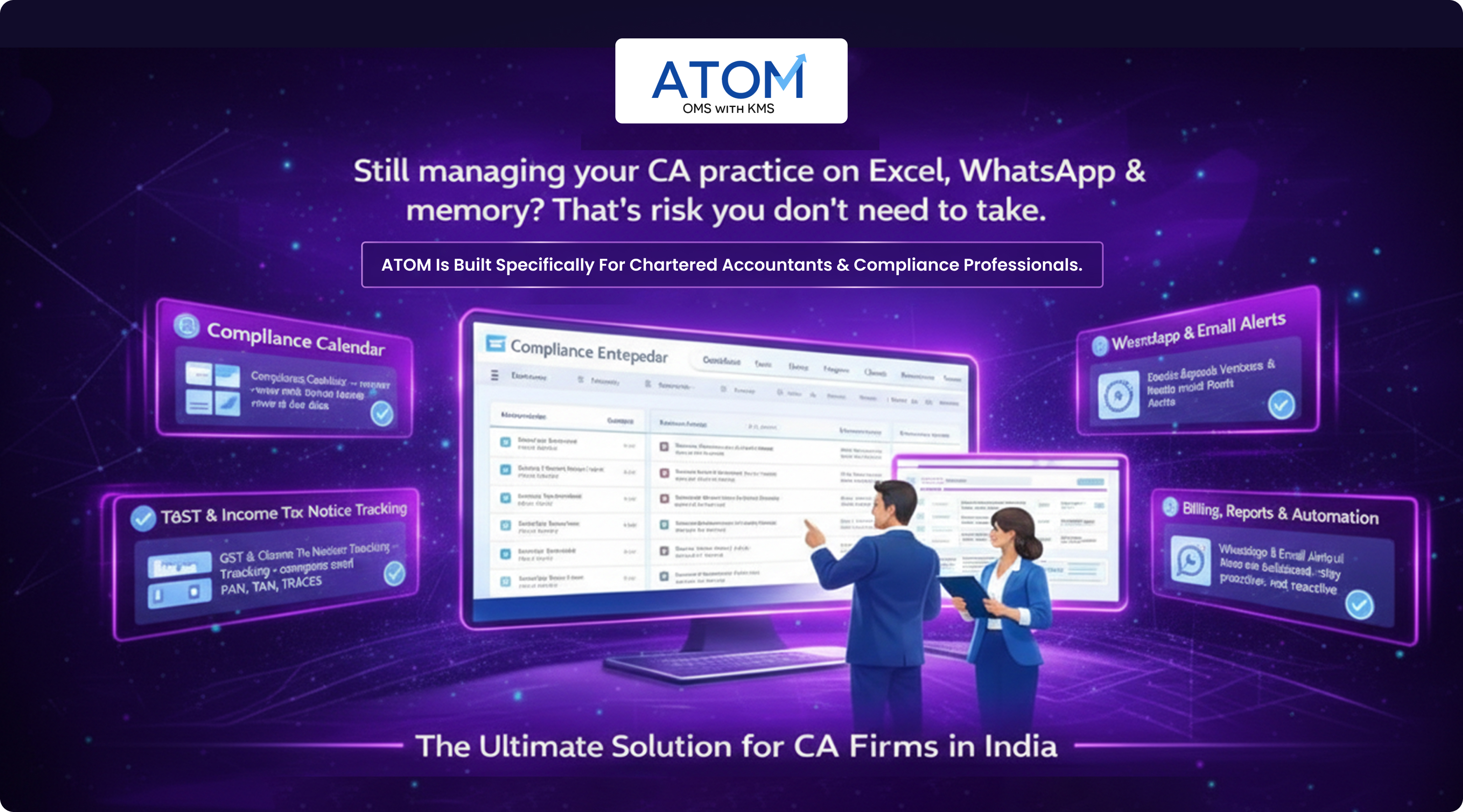
ATOM Compliance Calendar: Built for Indian CA Firms
ATOM’s Compliance Calendar is designed specifically around CA workflows, not adapted from generic project
tools.
Key strengths of ATOM:
Client-Specific Compliance Mapping
Each client is automatically mapped based on:
• Entity type
• Registrations (GST, TAN, CIN, etc.)
• Applicable laws and frequency
This eliminates irrelevant or missed compliances.
Due Date + Task Integration
Every compliance:
• Creates a task
• Assigns a responsible team member
• Tracks real-time status
No parallel systems. No confusion.
Automated Reminder & Escalation System
• Internal reminders before due dates
• Escalation for overdue tasks
• Optional client notifications
The system follows up—even when humans forget.
Why a Compliance Calendar Is a Risk Management System
A compliance calendar:
• Protects the firm from penalties
• Protects clients from notices
• Ensures operational discipline
• Enables predictable scaling
For CA firms, it is risk management infrastructure, not optional software.
Who Needs a Compliance Calendar the Most?
• CA firms with 50+ clients
• Firms handling GST + IT + MCA together
• Growing practices onboarding new staff
• Firms aiming for process-driven growth
• Professionals tired of last-minute compliance stress
Conclusion: Compliance Is Not About Memory—It’s About Systems
In today’s regulatory environment, manual compliance tracking is a liability.
A well-designed compliance calendar:
• Eliminates dependency on individuals
• Creates consistency
• Builds client trust
• Enables stress-free growth
For Chartered Accountants, it is no longer about working harder—but about working through systems.
Vider Contact Details: