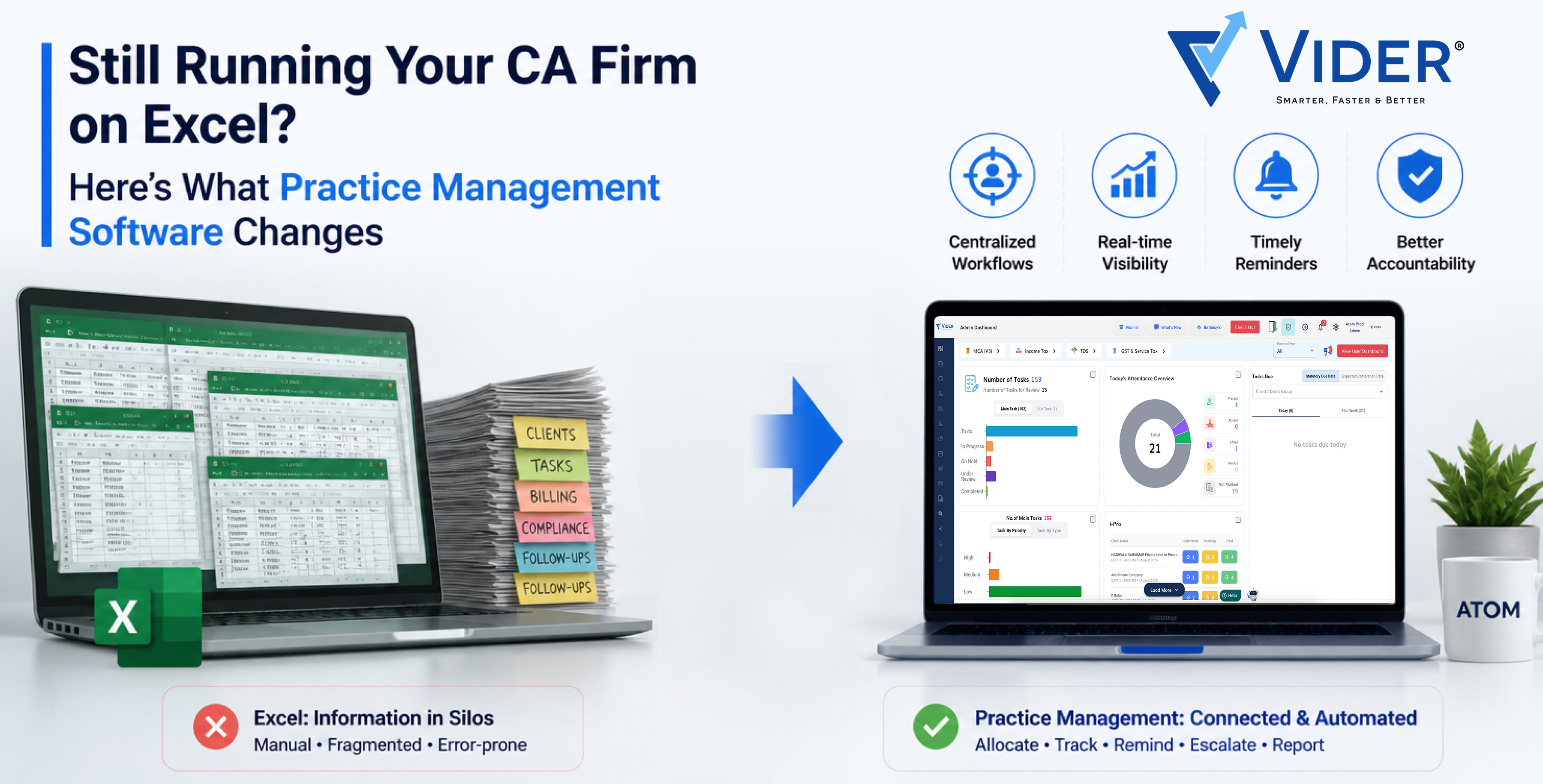
Still Running Your CA Firm on Excel? Here's What Practice Management Software Changes
Why growing CA firms outgrow spreadsheets and how ATOM replaces fragmented Excel-based workflows with a connected practice management system
Why growing CA firms outgrow spreadsheets and how ATOM replaces fragmented Excel-based workflows with a connected practice management system
CONTENTS
Home Chronicles ATOM


Excel is incredibly useful.
For many Chartered Accountants firms, it starts as a simple and flexible way to manage clients, tasks, billing, compliance, employee work, and follow-ups.
But there is a point where Excel stops being a productivity tool and starts becoming an operational dependency.
One sheet for clients.
Another for tasks.
Another for billing.
Another for compliance.
Another for employee work.
Another for follow-ups.
And eventually, someone asks:
"Which Excel file has the latest updates?"
That's the warning sign.
The problem isn't Excel itself. The problem is that a growing professional firm needs connected workflows, while spreadsheets primarily record information without actively driving the process.
As the number of clients, employees, and assignments increases, spreadsheet-based systems become increasingly difficult to maintain.
Firms may experience:
A spreadsheet can tell you what was enetered.
But it does not necessarily ensure that the right person receives the task, gets a reminder, completes it on time, or escalates it when necessary.
That difference becomes significant as the firm grows.
Consider a simple task.
With Excel, the process may look like:
Task -> Enter Status -> Updates Sheet
With a practice management system, the workflow can become:
Task → Allocate → Track → Reminder → Escalation → Completion → Reporting
The second approach creates an operational process around the work instead of simply maintaining a record of it.
This is where dedicated CA practice management software becomes valuable.
It helps firms move from manually updating information to systematically managing the work itself.
ATOM brings professional practice workflows into a centralized system, helping firms reduce their dependence on disconnected spreadsheets and manual processes.
Instead of maintaining separate systems for different operational activities, ATOM helps firms manage:
The goal isn't to eliminate Excel completely.
Excel will continue to be useful for Analysis, calculations, and many other business activities.
The goal is to eliminate the need for Excel to run the entire firm.
Instead of asking:
“Who updated the Excel sheet?”
partners and managers can focus on:
“What requires my attention?”
That is the real purpose of practice management software.
A dedicated practice management system becomes increasingly valuable for firms that are experiencing:
For smaller practices, spreadsheets may work for a period of time. But as operational complexity increases, connected workflows become more important.
ATOM is designed to help CA, CMA, CS, tax, and legal professionals move from fragmented processes to a more structured practice management system.
Is Excel still useful for CA firms?
Absolutely. Excel remains useful for calculations, analysis, data preparation, and many other activities. The challenges arises when a firm depends on multiple spreadsheet to manage its entire operation.
Why should a CA firm move from Excel to practice management Software?
As firms grow, spreadsheets can lead to duplicate data, missed updates, poor accountability, manual reporting, and communication gaps. Practice management software creates connected workflows around the information.
Can ATOM replace all Excel usage in a CA firm?
The objective is not necessarily to eliminate Excel. ATOM is designed to manage core practice workflows such as tasks, clients, compliance, documents, billing, and reporting so firms don't have to depend on Excel for their entire operation.
Is ATOM suitable for growing CA firms?
Yes. ATOM is designed around professional practice workflows and help firms manage increasing number of clients, employees, tasks, and compliance activities through a centralized system.
Related Posts
Best Practice Management Tool for Chartered Accountants in India by CA Chikyala Abhinav Why ATOM Is the Best Practice Management Tool for Chartered Accountants in India by Nikhil Katkam P F A & Associates - Segment: Income Tax Advisory & Compliance How ATOM & ATOM Pro Revolutionized My CA Practice: A Journey by CA. Naveen Kumar Best Company Secretary Software in India - Vider ATOM