Home
Chronicles
ATOM
How to Create Standard Operating Procedures for a CA Firm Without Making Every Task Rigid
ByNikhil Katkam |
Updated on: Nov 20, 2026 11:15
|
5 min read
Introduction: What Happens When Your Most Experienced Employee Is Unavailable?
Imagine that your firm's most experienced employee is on leave during a critical filing period.
Another team member takes over the assignment but cannot find the latest checklist. The supporting documents are stored in different locations, an important review step is known only to the original employee, and the partner must spend time explaining the process again.
This situation is not unusual in professional firms where operational knowledge develops through experience but is never formally documented.
The solution is not to turn every professional activity into a rigid set of instructions. It is to create standard operating procedures (SOPs) for CA firms that document repeatable work while leaving room for professional judgement.
A good SOP helps the team understand what needs to happen, who is responsible, which checks are necessary and when a task is ready to move forward.
What Should an SOP Contain?
An SOP should be short enough to use during actual work and detailed enough to prevent avoidable confusion.
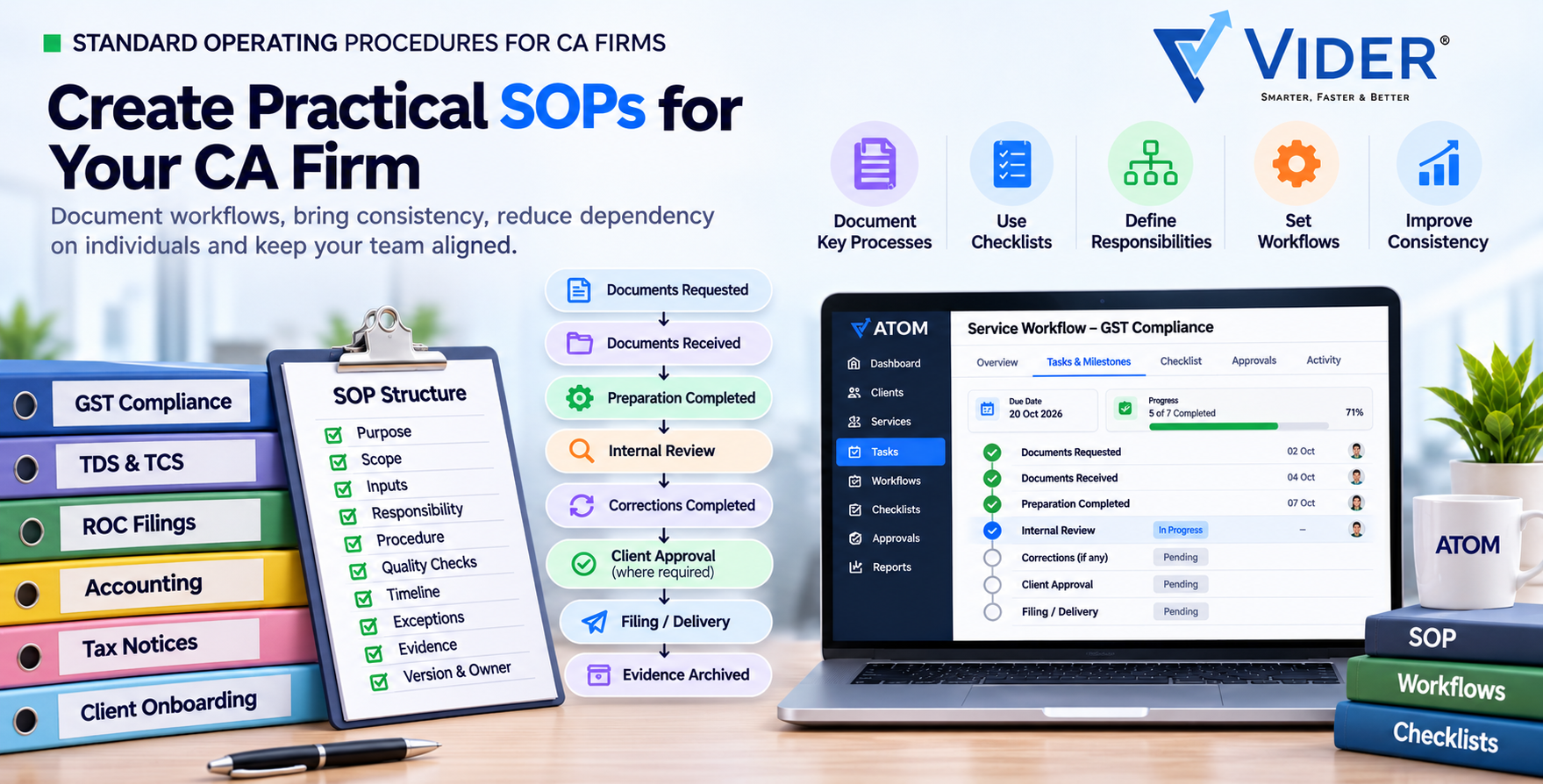
For each recurring service, document:
- Purpose: What the service is intended to achieve.
- Scope: Which activities are included and excluded.
- Inputs: Documents, information and approvals required.
- Responsibility: Who prepares, reviews and approves the work.
- Procedure: The main steps in the correct sequence.
- Quality checks: What must be verified before proceeding.
- Timeline: Internal target dates and relevant external deadlines.
- Exceptions: What to do when information is missing or an unusual situation arises.
- Evidence: What records or acknowledgement must be retained.
- Version and owner: Who maintains the procedure and when it was last reviewed.
Not every SOP needs ten elaborate sections. For a simple recurring task, a concise checklist may be sufficient. More complex assignments may require a detailed procedure.
1. Start With High-Volume, Repeatable Services
Do not attempt to document every activity in the firm at once.
Begin with services that are performed frequently, involve multiple employees or have clearly defined recurring steps.
Examples include routine GST compliance, TDS-related work, recurring accounting assignments, annual company filings and standard document collection processes.
For each service, ask the employee who performs it to explain the real process, not merely the process management assumes is being followed.
Document the actual steps, identify unnecessary repetition and agree on a standard method with the relevant reviewer.
2. Standardise the Process, Not Every Professional Decision
This distinction is essential.
An SOP can standardise how documents are collected, how source data is verified, how work is assigned, how observations are recorded and how the final deliverable is reviewed.
It should not force staff to reach the same professional conclusion in every situation regardless of the facts.
For example, the procedure for reviewing a tax notice can establish a sequence for collecting facts, examining the notice, identifying deadlines, researching applicable law and preparing a draft for professional review.
The conclusions still depend on the circumstances of the case and the judgement of the responsible professional.
Standardise the repeatable steps. Preserve professional judgement for the decisions that require it.
3. Convert Procedures Into Checklists and Workflow Stages (Milestones)
A document stored in a shared folder is useful only if employees can find and apply it.
For operational adoption, convert the key steps into a checklist or task workflow wherever practical.
For example, a recurring service could follow this sequence:
Documents requested → Documents received → Preparation completed → Internal review → Corrections completed → Client approval, where required → Filing or delivery → Evidence archived
Each stage should have a clear owner and completion condition.
This allows the firm to distinguish work that has genuinely progressed from work that has merely been marked as complete.
4. Assign an Owner to Every SOP
An SOP should not become an outdated document that nobody maintains.
Assign an owner who is responsible for reviewing the procedure when regulations, portal requirements, internal policies or service delivery methods change.
A practical review cycle can include:
- Scheduled reviews for critical procedures.
- Updates following significant regulatory or portal changes.
- Changes following recurring review observations.
- Feedback from staff who execute the process.
- Approval of material changes by the relevant senior or partner.
Where statutory requirements are involved, verify updates against appropriate official sources before revising the procedure. An SOP records how the firm works; it does not replace current legal research, technical guidance or professional review.
5. Measure Whether the SOP Is Actually Working
Document creation is only the beginning. Adoption matters more.
Track a small set of meaningful indicators, such as:
- Percentage of assignments completed using the prescribed workflow.
- Number of assignments returned for correction.
- Delays caused by missing client information.
- Time spent at each major stage.
- Repeated deviations from the approved process.
- Frequency of outdated or incomplete supporting records.
These indicators help management identify whether a procedure needs improvement or whether the team needs additional training.
6. Use ATOM to Support Repeatable Workflows
ATOM by VIDER supports service configuration, checklists, milestones, subtasks, task allocation and approval workflows.
These capabilities can help translate documented procedures into operational tasks that employees can execute and managers can monitor.
For example, a firm can define the milestones of a recurring service, establish the required subtasks and make progress visible through the task workflow. See how firms automate recurring tasks and implement ATOM step by step.
The SOP explains the agreed method. The workflow helps the team follow that method consistently.
Conclusion
A CA firm's most valuable operational knowledge should not exist only in the memory of a few experienced employees.
Well-designed SOPs make processes easier to transfer, review and improve. They help new employees learn faster, support continuity when team members change and reduce avoidable variation in routine work.
Start with a few important services, involve the employees who perform them and review the procedures based on actual outcomes.
The objective is not to remove flexibility from professional work. It is to stop repeating the same avoidable confusion every time the work is performed.
Turn your firm's documented processes into trackable workflows with ATOM.
Vider Contact Details: