Home
Chronicles
ATOM
The Maker-Checker System for CA Firms: Building Quality Control Into Every Assignment
ByNikhil Katkam |
Updated on: Nov 5, 2026 11:28
|
7 min read
Introduction: Completion Is Not the Same as Quality
An employee completes a return, prepares a financial statement or drafts a response to a tax notice. The task is marked complete, and the next assignment begins.
But who verified the work? Were the supporting documents checked? Were discrepancies resolved? Was the final version reviewed and approved by the appropriate person?
In a Chartered Accountant firm, these questions matter because delivering professional work involves more than finishing a task on time.
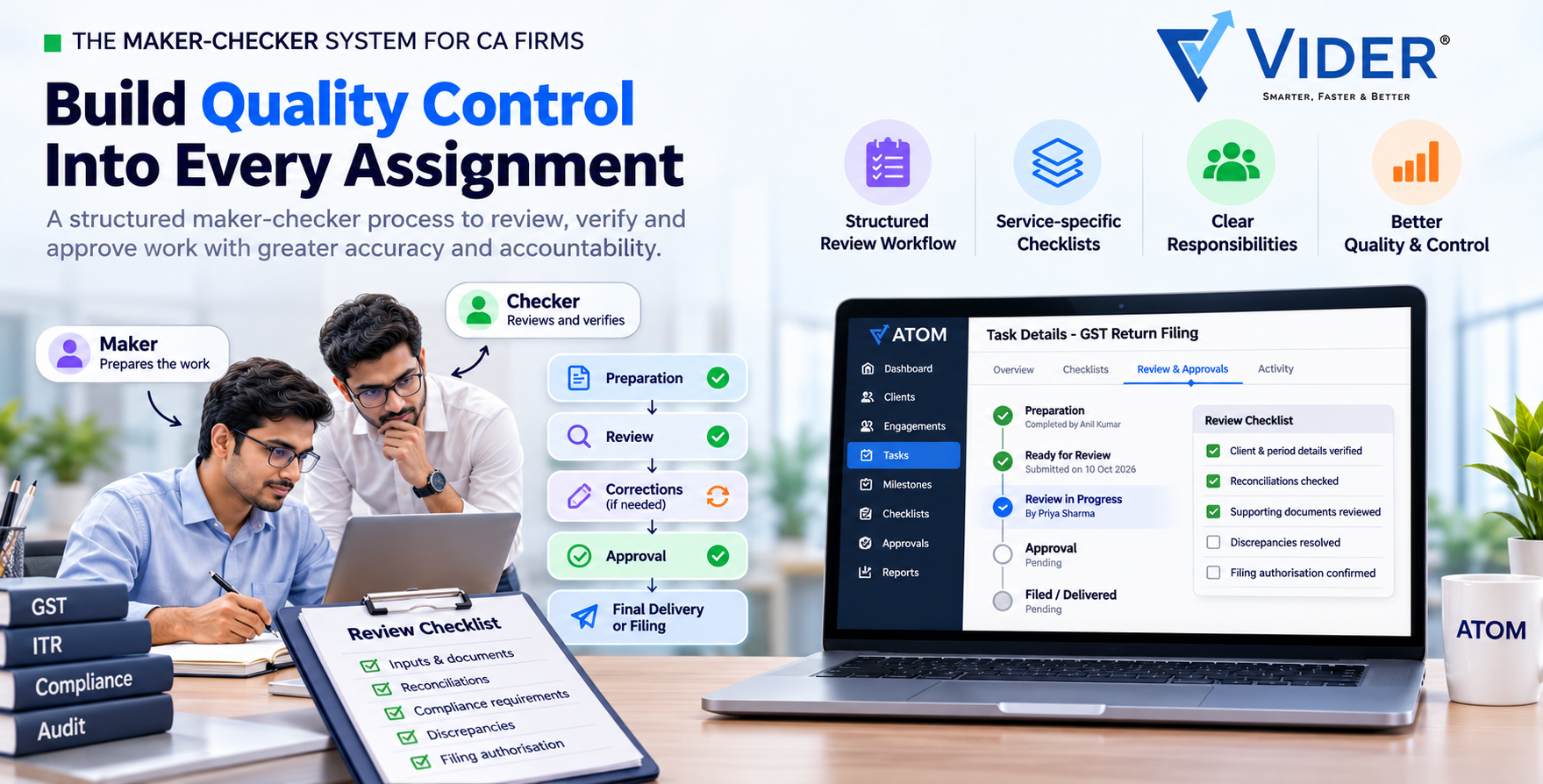
A maker-checker process for CA firms introduces a structured separation between preparing work and reviewing it. It creates a defined checkpoint where another authorised person verifies the output before it moves to the next stage.
The purpose is not to slow down delivery. It is to make quality control a part of the workflow rather than an activity that happens only when a problem is discovered.
What Is a Maker-Checker Process?
The maker is the person responsible for preparing the work. The checker is the person responsible for reviewing it against the relevant requirements.
Depending on the assignment, the process may also include a final approver.
A typical workflow looks like this:
Preparation → Self-check → Independent review → Corrections, if required → Approval → Final delivery or filing
For example, a team member preparing a compliance filing may verify the client information and attachments. A reviewer then checks the material fields, supporting documents and applicable requirements before authorisation to proceed.
The review depth should depend on the nature and risk of the assignment.
Why Informal Review Processes Often Fail
Many firms already have experienced seniors reviewing junior staff work. The problem is not necessarily the absence of review; it is the absence of a consistent, visible process.
Common weaknesses include:
- Work being sent for review without a clear completion checklist.
- Review comments being scattered across calls, messages and documents.
- Unresolved observations not being tracked.
- The preparer assuming that silence means approval.
- Partners becoming the bottleneck for routine reviews.
- No reliable record of who reviewed the work and when.
These gaps make it difficult to identify whether delays arise during preparation, review or correction.
1. Define Review Stages for Each Type of Assignment
Not every service requires the same review process.
A routine recurring compliance task may need a concise checklist and designated reviewer. A complex tax-litigation assignment may require a more detailed review of facts, legal positions, evidence and deadlines.
Start by identifying the services your firm performs most frequently. For each service, define:
- Required inputs and supporting documents.
- The employee or role responsible for preparation.
- The review criteria.
- The authorised reviewer.
- Conditions that prevent the task from advancing.
- Evidence required before the task can be marked complete.
This creates a repeatable process without forcing every assignment into an identical template.
2. Use Checklists to Make Reviews Consistent
A checklist helps the preparer and reviewer evaluate the same critical points.
For instance, a review checklist for a compliance assignment might cover client identity, period, source data, reconciliations, supporting documents, material discrepancies and filing authorisation.
Checklists should be practical and service-specific. A long checklist that staff complete mechanically will not improve quality.
The objective is to make important checks visible, repeatable and easy to verify.
3. Separate Preparation, Review and Approval Statuses
A single “In Progress” or “Completed” status hides too much information.
Consider a workflow with explicit stages:
- Pending preparation
- Preparation in progress
- Ready for review
- Review in progress
- Corrections required
- Approved
- Filed or delivered
Management can then see where work is waiting and who needs to act next.
A reviewer should not need to ask the preparer for a status update simply to understand whether an assignment is ready for review.
4. Record Review Observations and Corrections
A review is useful only when the observations lead to action.
Every material observation should identify the issue, responsible person and expected resolution. Once corrected, the item should return for verification where necessary.
Tracking repeated observations also reveals training opportunities. If several employees repeatedly miss the same requirement, the firm may need a better checklist, clearer instructions or targeted training.
This turns review data into a way to improve the process, rather than merely correcting individual mistakes.
5. Assign Review Authority Based on Risk
A maker-checker process should not mean that every minor task waits for the managing partner.
Define review authority according to service complexity, risk, employee experience and the firm's internal policies. Routine work may be reviewed by an appropriate senior, while sensitive or complex assignments may require partner-level review.
Professional and statutory sign-off requirements must still be followed wherever applicable.
How ATOM Can Help Structure the Review Workflow
ATOM supports task stages, subtasks, checklists, milestones and configurable approval workflows. These capabilities can help CA firms make assignment progress and review responsibilities more visible.
The firm can organise work so that preparation, review and completion are distinct stages, instead of relying entirely on informal messages. Read more about task management in ATOM.
Software supports the process; it does not replace the professional judgement, competence or statutory responsibility of the reviewer.
Conclusion
A reliable maker-checker process protects more than the final deliverable. It improves accountability, helps teams learn from recurring errors and gives partners greater visibility into the quality of work moving through the firm.
Start with a few high-volume services, define their review checkpoints and measure how consistently the process is followed.
Quality should not depend on who happens to remember to review a task. It should be built into the way the firm works.
Discover how ATOM can help structure task stages, checklists and approval workflows for your practice.
Build More Visible Review Workflows with ATOM
Build more visible review workflows with ATOM.
Explore ATOM · Book a live demo · +91 91711 21121
Vider Contact Details: