Home
Chronicles
ATOM
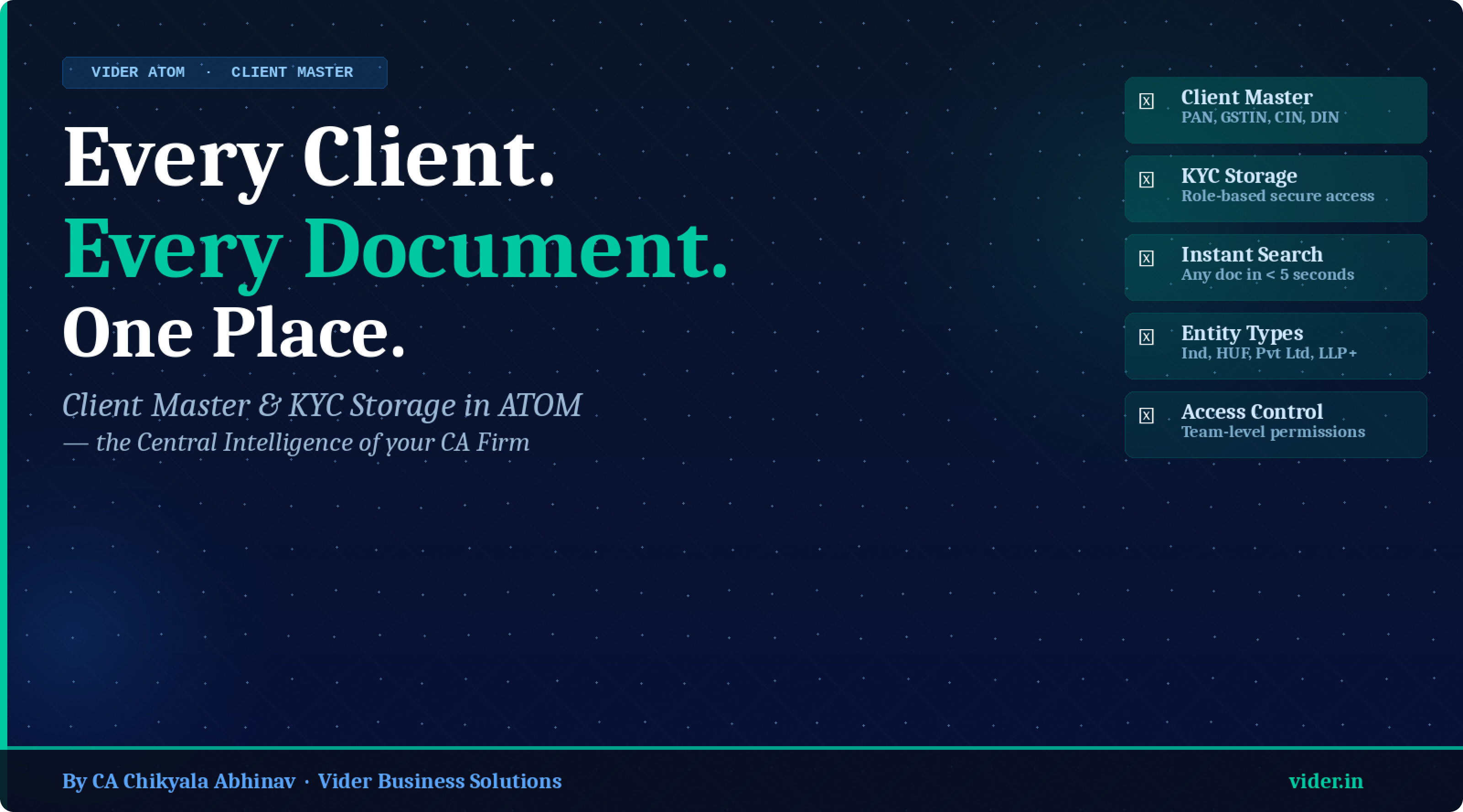
Every Client. Every Document. One Place: Client Master & KYC Storage in ATOM
By CA Chikyala Abhinav |
Updated on: Apr 23, 2026 16:30
|
15 min read
Introduction: The Client Data Problem
Ask any CA firm partner where their client's GSTIN is. Then ask for the CIN of their company
client. Then the DIN of one of the directors. In most firms, the answer involves opening at
least
three different places — an Excel file, an email search, and possibly a physical file. Sometimes
the answer is 'I'll have to check.'
This is not a knowledge problem. It is a systems problem. When client data lives in multiple
disconnected places — spreadsheets, email attachments, WhatsApp forwards, physical folders — it
is
inevitably incomplete, duplicated, and difficult to retrieve. The result is wasted time,
unnecessary client follow-ups, and the occasional embarrassing moment when a CA does not know
basic
facts about their own client.
ATOM's Client Master module solves this definitively. Every piece of client information, every
KYC
document, every registration number, and every entity detail lives in one place — structured,
searchable, and secure.
What a Proper Client Master Must Contain for a CA Firm
A CA firm's client master is not just a contact list. It is the operational foundation of every
engagement. For the system to be useful, it must capture:
- Full legal name and trade name of the entity
- Entity type: Individual, HUF, Proprietorship, Partnership, LLP, Private Limited, Public
Limited, OPC, Trust, AOP, BOI
- Primary identifiers: PAN, GSTIN (all registrations), CIN, LLPIN, TAN, Aadhaar (for
individuals)
- Director/Partner/Trustee details with DIN where applicable
- Registered address, communication address, and correspondence preferences
- Financial year and accounting year details
- Applicable registrations and compliance obligations
- Date of incorporation/registration and anniversary dates
- Assigned partner and handling team members
- KYC documents: PAN card, Aadhaar, incorporation certificate, partnership deed, etc.
- Bank account details for reference (not for transactions)
- Engagement history and services availed
“The Client Master is not a feature of ATOM — it is the foundation of ATOM. Everything else
—
tasks, deadlines, notices, billing — flows from knowing exactly who your client is.”
ATOM's Client Master: A Deep Dive
Structured Entity Profiles
Every client in ATOM has a structured profile page. The system presents the right fields based
on
entity type — so an Individual profile asks for different information than a Private Limited
Company
profile. This structure prevents incomplete data entry and ensures consistency across the firm's
entire client base.
Bulk Import from Existing Records
For firms migrating from spreadsheets or other tools, ATOM supports bulk client data import. The
Vider onboarding team assists with data migration, ensuring that existing client records are
transferred accurately into the structured ATOM format.
KYC Document Storage with Version Control
Every KYC document uploaded to a client's profile in ATOM is stored with metadata: document
type,
upload date, uploaded by, and a version number. When a PAN card is re-issued or an address proof
is
updated, the new document is uploaded as a new version — the old one is retained for audit trail
purposes. No document is ever lost.
Instant Search Across All Clients
ATOM's search function works across all client profiles simultaneously. Type a PAN number, a
company
name, a GSTIN, or a CIN — and the relevant client profile appears instantly. No more manual
searching through spreadsheets or email archives.
| Data Category
|
Fields
Captured |
Why It Matters
|
| Tax Identifiers |
PAN, GSTIN(s), TAN, Aadhaar
|
Needed for every compliance
task |
| Corporate IDs |
CIN, LLPIN, DIN of directors
|
MCA/ROC filings and notices
|
| Entity Details |
Type, incorporation date, FY
|
Determines compliance calendar
|
| KYC Documents |
PAN card, Aadhaar, cert. of
incorp. |
Regulatory and onboarding req.
|
| Team Assignment |
Partner, manager, handler |
Accountability and task routing
|
Role-Based Access to Client Data
Not all team members should have access to all client information. A junior article clerk
working
on routine GST filings does not need to see the full financial profile of a high-net-worth
individual client. ATOM's role-based access control ensures that each team member sees only the
client data relevant to their work — protecting sensitive information without hampering
productivity.
Common Questions from CA Firms
How many clients can ATOM handle in the client master?
ATOM is designed to scale from solo practitioners with 20 clients to large firms with 2,000+
clients. The search and filter functions remain fast regardless of database size. There is no
practical limit on the number of client profiles.
Can multiple GSTIN registrations be stored for one client?
Yes. Many companies have multiple GST registrations across states. ATOM allows multiple GSTIN
entries under a single client profile, each tagged with the relevant state and registration
type.
What happens to client data if we stop using ATOM?
Your data belongs to you. Vider provides full data export in standard formats (Excel, CSV) on
request. There is no data lock-in.
Vider Contact Details: