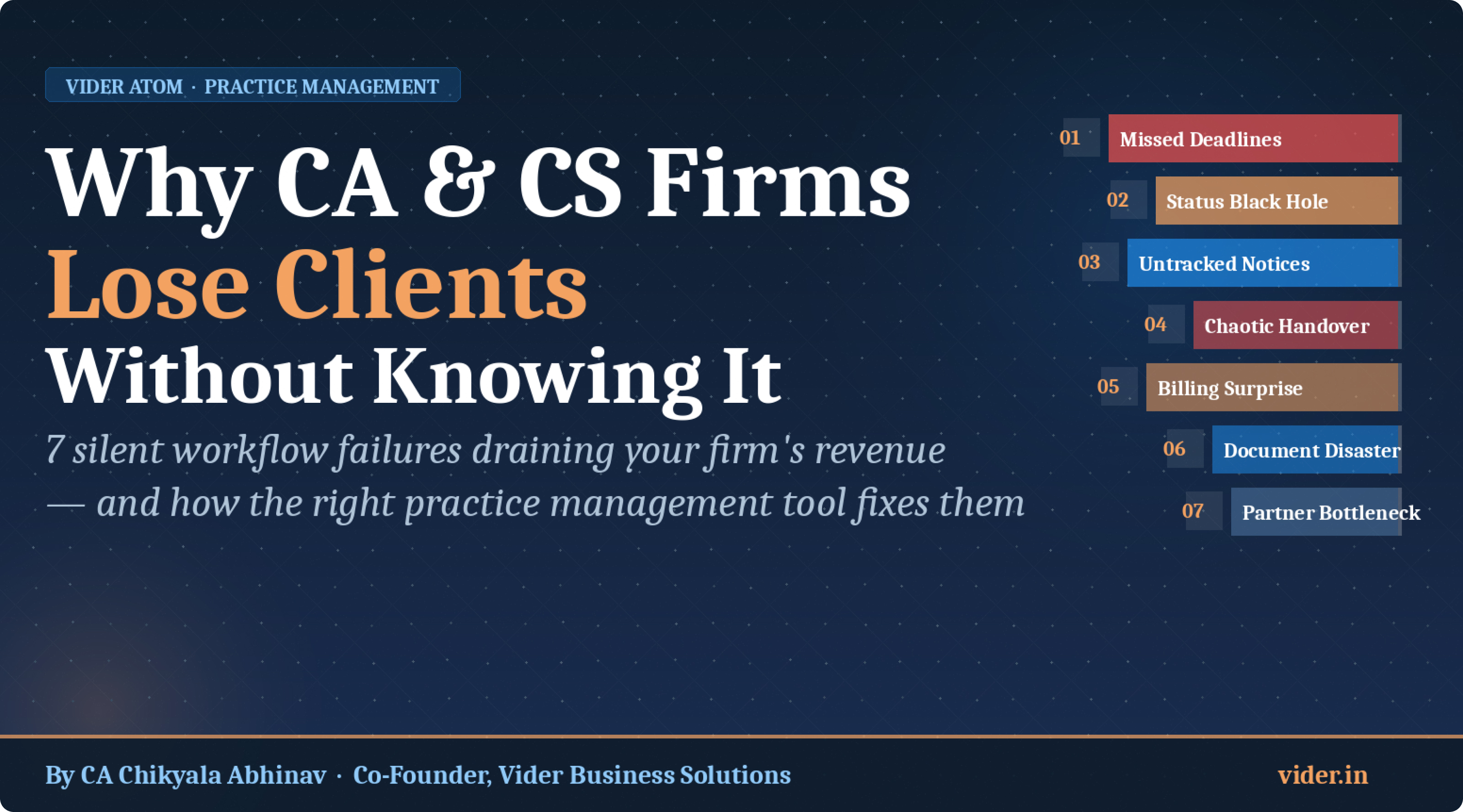
Why CA & CS Firms Lose Clients Without Even Knowing It
7 silent workflow failures draining your firm's revenue — and how the right practice management tool, office management tool, and notice management tool eliminates each one permanently.
7 silent workflow failures draining your firm's revenue — and how the right practice management tool, office management tool, and notice management tool eliminates each one permanently.
CONTENTS
Home Chronicles ATOM


Why CA & CS Firms Lose Clients Without Even Knowing It
7 silent workflow failures draining your firm's revenue — and how the right practice management tool, office management tool, and notice management tool eliminates each one permanently.
By CA Chikyala Abhinav · Co-Founder, Vider Business Solutions · Practising CA, Telangana
The client who leaves a CA or CS firm rarely says why. They just stop calling. They quietly move to a competitor. And the firm never traces it back to the real cause: a workflow failure that was completely invisible — until the client was gone.
This is the most underestimated business problem in Indian professional practice. While most conversations about firm growth focus on business development — getting new clients — far too little attention goes to retention: keeping the clients you already have.
The economics are stark. Acquiring a new client costs five to seven times more than retaining an existing one. For a CA or CS firm with an average client lifetime value of 80,000–3,00,000 spread across ITR, GST, MCA, audit, and advisory, a single lost client represents a significant revenue hole that takes months of business development effort to fill.
What causes the loss? Almost never the quality of the CA's technical knowledge — that is increasingly commoditised. Almost always the quality of the operational experience the client receives. In other words: workflow failures.
Here are the 7 most common silent workflow failures in Indian CA and CS firms — the ones your clients notice before you do — and exactly how a purpose-built practice management tool eliminates each one.
It's not the missed deadline that kills the relationship. It's the fact that the client found out from the government portal — not from you.
Indian CAs and CSs operate inside one of the world's most complex compliance calendars. GST monthly and quarterly filings, TDS quarterly returns, advance tax instalments, ITR annual deadlines, MCA annual returns, ROC event-based filings, FEMA reporting — the list runs into dozens of dates per client per year. Managing this across 100, 200, or 500 clients without a system is not difficult. It is impossible.
A missed GST filing triggers late fees and interest that the client pays — and immediately blames the CA for, even if they provided documents late. A missed ROC annual return can trigger strike-off proceedings. A missed TDS return leads to prosecution risk. The penalty is financial; the relationship cost is deeper.
Client experience: "My CA missed my GSTR-3B and I got a late fee. I don't feel they're on top of things." — This thought, unspoken, begins the mental process of switching.
ATOM's compliance calendar automatically generates tasks for every due date — GST, TDS, ITR, MCA, ROC — for every client, based on their profile and applicable filings. Approaching deadlines surface automatically. Overdue items escalate to the partner. Nothing falls through the gap.
Your client's ITR is being prepared. Or is it filed already? Or is it waiting for a document? They don't know. You don't answer immediately when they call. They feel anxious, then irritated, then they start wondering if there's a CA who is more available.
The status black hole — the period between a client handing over a task and receiving confirmation of completion — is the most fertile ground for client dissatisfaction in professional practice. It's not that work isn't happening. It's that the client can't see it happening. Modern clients have been trained by technology to expect real-time visibility. They can track their Swiggy order to the street. And then they hand a six-lakh tax audit to their CA and hear nothing for three weeks.
When clients don't receive proactive updates, they assume the worst. Proactive communication — even brief status messages — increases client satisfaction scores dramatically. The best office management tool for CA firms enables this proactively, not reactively.
Clients call to ask "where is my work?" — a question that should never need to be asked. Each such call costs 10–15 minutes of partner or manager time, adds to client anxiety, and signals operational immaturity.
Client experience: "I have to call them every time to know what's happening. It feels like they don't have a system."
Every task has a clear status — assigned, in progress, under review, completed. Partners can see firm-wide status at a glance and proactively update clients. WhatsApp and email notifications can be triggered on completion, keeping clients informed without manual effort.
Income Tax notices. GST show-cause notices. PAN-Aadhaar mismatch letters. TDS default notices. A growing CA or CS firm receives a continuous stream of these — across dozens or hundreds of clients. Each one has a deadline. Each one has consequences for non-response.
Without a dedicated notice management tool, the typical process is: the client forwards the notice via WhatsApp or email. It gets noted somewhere — sometimes in a register, sometimes on a sticky note, sometimes in someone's mental buffer. The response gets drafted. Sometimes it gets filed in time.
Sometimes the deadline passes, unnoticed.
A notice management failure is uniquely damaging because the consequences are irreversible. A missed response deadline in Income Tax can result in an ex-parte assessment. A missed GST show-cause response can result in demand confirmation. These cannot be undone — only appealed, at significant additional cost.
Client experience: "They missed the notice deadline. I got a demand. I'm furious. I'm leaving." — This is the failure mode that generates the strongest negative word of mouth.
ATOM Pro is a dedicated notice management tool and litigation management tool built for the Indian regulatory environment. Every notice is logged with type, authority, assessment year, demand amount, and auto-calculated response deadline. Escalation alerts go to the partner 7–14 days before deadline. Litigation is tracked across CIT(A), ITAT, High Court, and Supreme Court.
“A missed notice deadline is not an admin error. It is a clinical failure — equivalent to a hospital losing a patient's file. The client never forgets it.”
— From practice interviews with CA firm partners across India
Your best article clerk leaves. Or gets transferred to a different partner's portfolio. And the client's work — their history, their pending tasks, their documents, their compliance status — exists entirely inside that one person's head and email inbox.
Work Knowledge Lives in Individuals, Not the System
When a team member leaves or changes, client service continuity breaks. Documents are hunted across personal email accounts. Pending tasks are discovered through client follow-ups. The client feels the chaos even when the firm tries to hide it.
Client experience: "Every time someone new handles my work, I have to explain everything from scratch. This firm doesn't have their house in order."
Every client's complete history — all tasks, all documents, all communications, all compliance records — lives in ATOM, not in individual inboxes. Reassigning a client's work to a new team member takes minutes. The new handler has full context immediately.
The client expected to pay 15,000 for the year. The invoice comes in at 28,000. They had no visibility into what was being done, no understanding of why the additional work was necessary, and no warning that costs were escalating. The invoice lands as a shock.
Billing disputes are among the most relationship-damaging events in professional practice — not because the fees were necessarily wrong, but because the communication around them was absent.
Clients who trust their CA will absorb a higher bill if they understand it. Clients who feel blindsided will dispute it, resent it, and leave.
When billing is disconnected from work records, invoices feel arbitrary to clients. There is no evidence of what was done, how much time was spent, and why additional charges arose. The trust deficit this creates outlasts the specific billing dispute.
Client experience: "I never know what I'm going to be charged until the invoice arrives. It makes me feel like fees are made up."
ATOM's billing module links invoices to completed tasks and work records. Every line item on an invoice is traceable to actual work done. Partners can generate invoices from work completion records, giving clients clear, credible, work-backed billing statements.
The client asks for a copy of last year's ITR. The CA asks them to wait while they search. Two days later, after rummaging through physical files or email archives, the document surfaces — or doesn't.
For the client, this is a fundamental signal: their CA firm does not have organised records.
When client documents can't be retrieved quickly — or worse, when they're lost — the firm's credibility suffers deeply. This is especially critical for ITR acknowledgements, audit reports, GST returns, and company incorporation documents that clients may need years later.
Client experience: "I asked for my Form 16A from two years ago and they took a week to find it. Are my records safe with them?"
ATOM maintains client-wise digital document folders with organised storage for all uploaded files — KYC documents, tax returns, audit reports, financial statements, correspondence. Any document is retrievable in seconds, with role-based access control to protect sensitive information.
As a CA or CS firm grows, a predictable bottleneck emerges: the partner. Everything waits for partner approval. Every client query gets routed to the partner. Every important decision requires the partner's attention. The partner becomes the single point of failure — and the single point of delay.
When the partner has no system for delegating, monitoring, and reviewing work, they become a constant bottleneck. Junior staff operate without clear direction. Senior staff duplicate effort. The firm's capacity ceiling is the partner's personal bandwidth.
Client experience: "Everything seems to wait for the partner. Work piles up. Responses are slow. I don't feel like I'm a priority."
ATOM's workload dashboard gives partners real-time visibility into every team member's task load, progress, and completion rates — without needing to ask or follow up. Partners can delegate with confidence, track without micromanaging, and review work through structured workflows rather than informal interruptions.
Here's how the two models compare across the seven failure points — and what your clients experience in each scenario:
7/7: Your practice is operationally mature. You're retaining clients through system quality.
4–6/7: You have partial systems. Some clients are at risk; you may not know which ones.
0–3/7: Significant operational risk. Client churn is likely underway — silently.
CA, CS & Finance Professionals Ask
ATOM by Vider is widely regarded as one of India's leading practice management tools for Chartered Accountants, Company Secretaries, and finance professionals. It combines client management, task automation, India's compliance calendar, team workload visibility, billing, and document storage in a single platform purpose-built for the Indian regulatory environment.
A notice management tool is software that tracks Income Tax, GST, PAN, ROC, and other regulatory notices end-to-end — from receipt through response and resolution. CA firms need one because missing a notice response deadline can result in ex-parte orders, demands, and penalties that are very difficult to reverse. ATOM Pro by Vider provides dedicated notice and litigation management for Indian CA and CS firms.
An office management tool prevents the 7 most common silent failures that cause client churn in professional firms: missed deadlines, poor communication, disorganised document management, slow onboarding, inconsistent service delivery, notice mismanagement, and lack of billing clarity. By systematising every workflow, firms deliver a more reliable, professional experience that keeps clients loyal.
Litigation management software for CA firms tracks all tax and regulatory disputes — from the initial notice through replies, appeals at CIT(A), ITAT, High Court, and Supreme Court levels. ATOM Pro by Vider offers integrated litigation management with automated deadline tracking, document trails, and demand monitoring across all appellate levels.
Most firms are operationally live on ATOM within one to two weeks. Client data migration is supported. The Vider team conducts structured onboarding including initial setup, data import, team training, and ongoing support. Most firms report operational benefit visible within the first month.
Your Clients Are Noticing What You Don't
Stop losing clients to workflow failures you can't see. Book a free demo of ATOM and ATOM Pro — India's leading practice management and notice management platform for CA, CS, and finance professionals.
Related Posts
Best Practice Management Tool for Chartered Accountants in India by CA Chikyala Abhinav Why ATOM Is the Best Practice Management Tool for Chartered Accountants in India by Nikhil Katkam P F A & Associates - Segment: Income Tax Advisory & Compliance How ATOM & ATOM Pro Revolutionized My CA Practice: A Journey by CA. Naveen Kumar Best Company Secretary Software in India - Vider ATOM